Modern Foreign Languages
MFL overview
The ability to speak a foreign language is a highly useful skill in a multicultural world. Not only does it facilitate travel and leisure; it can also open doors to a world of exciting career opportunities.
At Goldington Academy we aim to give all pupils, regardless of ability, the desire to speak and enjoy a foreign language. The MFL department is enthusiastic and dedicated in our approach to teaching; in short, we believe that language lessons should be exciting, inspiring and fulfilling!
Key Stage 3 curriculum
At Key Stage 3, all pupils at Goldington Academy study French. Teaching at this stage is supported by the “Dynamo” course from Pearson, which builds on logical progression and gives a taste of Francophone culture to offer a pupil-friendly approach to the challenges of language learning.
In Year 7, we aim to develop French speaking (including phonics) and listening skills through the use of songs, whole-class games and pair work. Lessons are exciting and interactive, with an emphasis placed on these two fundamental skills to develop confidence in the language. Simple grammar concepts are introduced and practised, and pupils are encouraged to write at sentence and paragraph level, describing the world around them, and presenting their likes and dislikes supported by reasons.
In Year 8, pupils continue to develop their pronunciation and understanding of the French language; speaking and listening skills are practised with enthusiasm every lesson and written tasks become an intrinsic part of their learning. Pupils are introduced to more complex grammar concepts (offering more sophisticated opinions, exploring verb conjugation and different tenses) and gain more confidence in writing with accuracy.
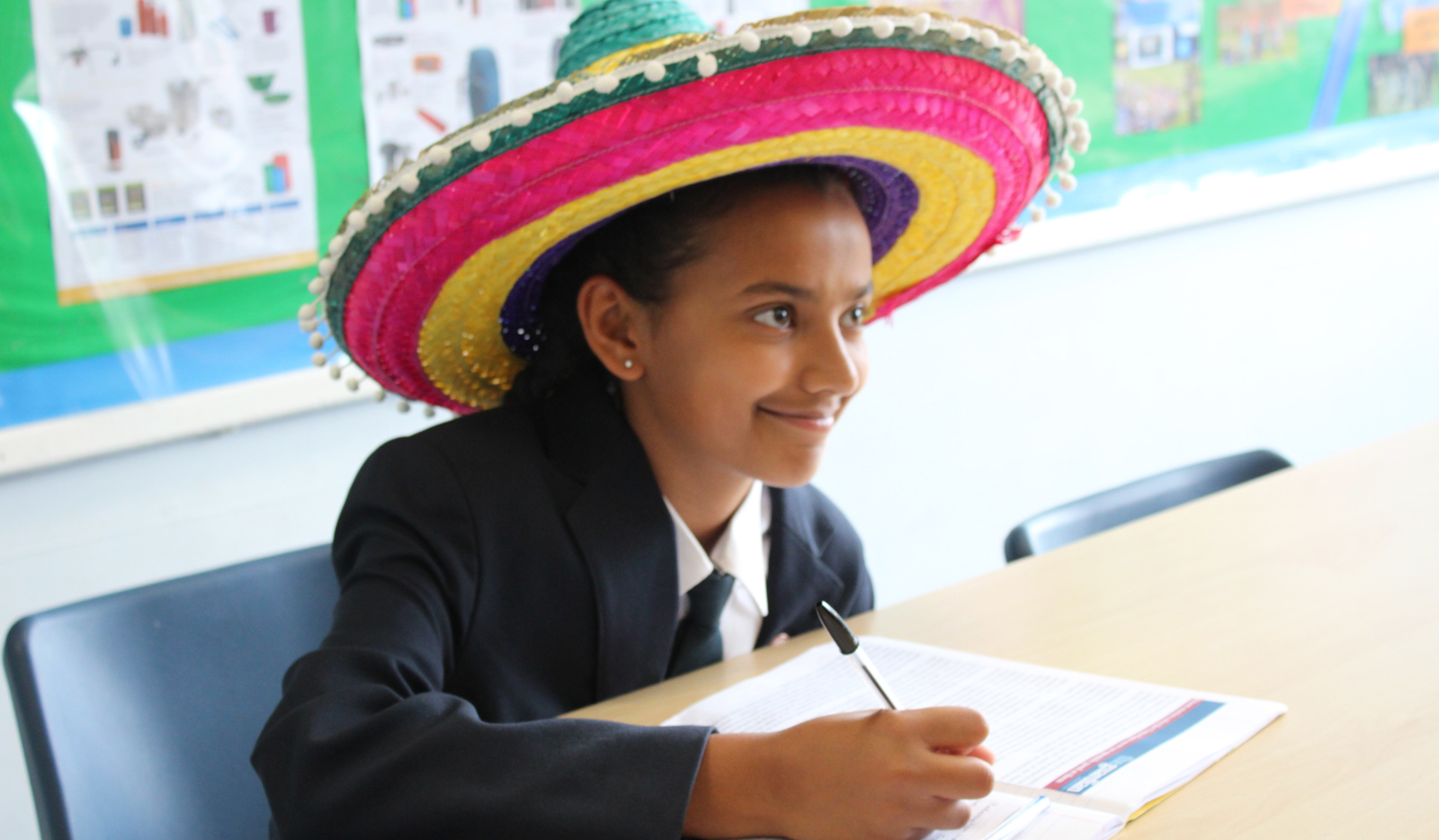
In Year 9, pupils continue with their French lessons while also beginning to study Spanish for one hour a week. In French, they start to consider topic areas in more depth, building on the language knowledge from Years 7 & 8 – considering family relationships and friendships, social media and technology, holidays and celebrations, school life and tourism. They consolidate their knowledge of three core tenses and explore more complex areas of grammar. In Spanish, students develop a strong foundation in the language by learning key vocabulary, basic grammar and essential communication skills. Once they have mastered the basics, they progress to a range of more in-depth and engaging topics that allow them to use the language in meaningful contexts. These include talking about their family and relationships, describing school life and subjects, discussing their hobbies and leisure activities, and exploring themes related to their home and neighbourhood. Through these topics, students build their confidence in speaking, listening, reading and writing in Spanish while gaining a greater understanding of Spanish-speaking cultures.
Key Stage 4 curriculum
We have a very high number of GCSE French pupils and a considerable number choosing to study the Spanish GCSE course, as well as some very talented 'dual linguists'. GCSE students follow the very popular ‘Studio’ course for French and the ‘Viva!’ course for Spanish, produced by Pearson, and are divided into ability sets (Foundation & Higher) for the appropriate level of challenge and support.
Both courses provide the grammatical structures and sophisticated vocabulary, as well as maintaining an authentic, fun and interactive approach to learning languages at this more advanced level. Of course, at GCSE students are consistently using and honing all four language skills – listening, reading, writing and speaking – on which they will be assessed in their final exams.
From September 2024, our GCSE students will be following new French and Spanish GCSE curricula, which is a more contemporary, more inclusive one, with a more student-friendly experience at its heart. Our Exam Board for the new GCSE exams – first sitting in June 2026 – will be Edexcel. Whilst there are currently practice and sample papers that we will use with students in lessons, we will not be able to upload past papers until they are available.
For our Y11 students only, following the existing GCSE curriculum: AQA French GCSE past papers and mark schemes
Click on the links below to find past papers and the related mark schemes for AQA French
We will highlight other past papers as they become available.