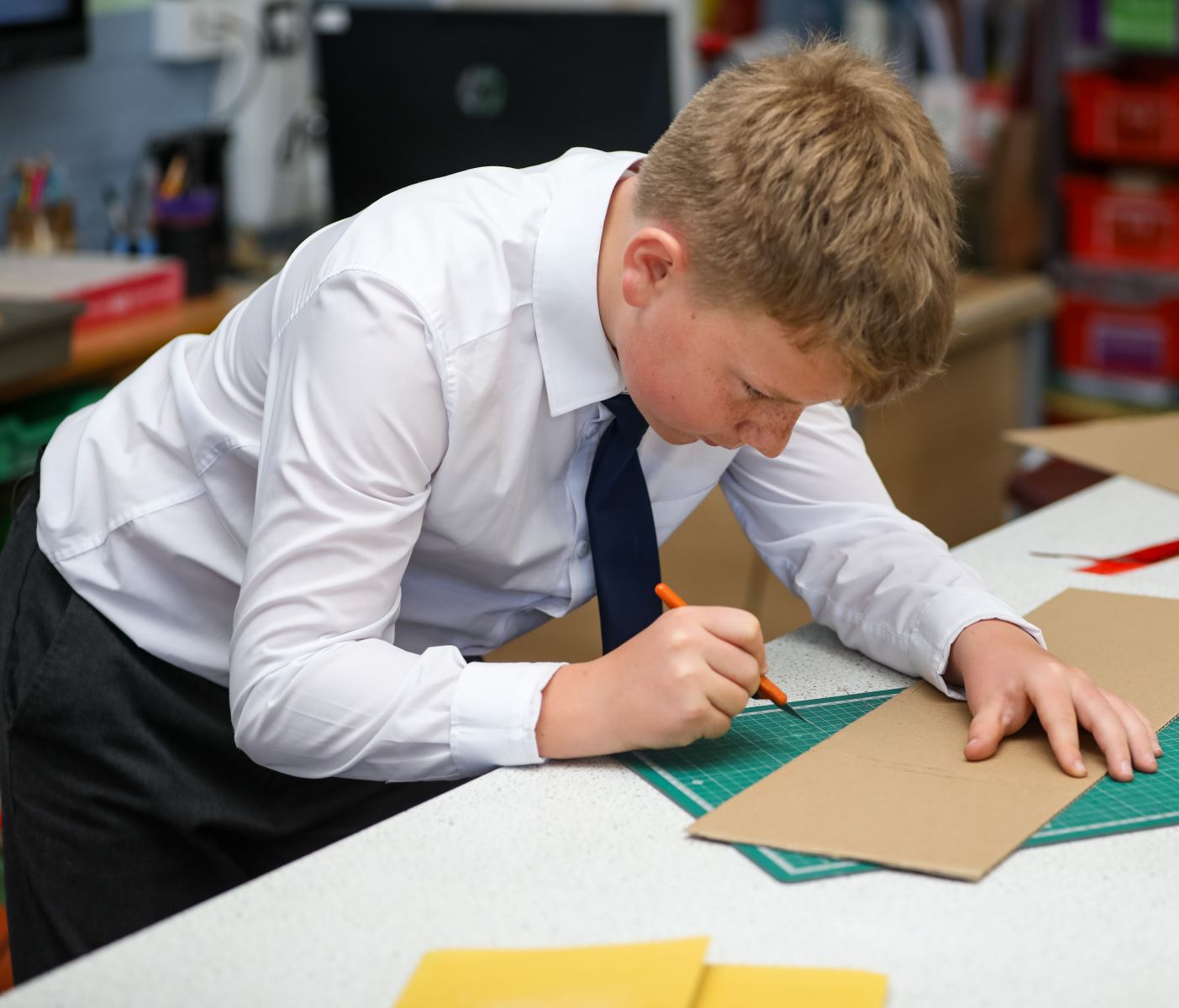
The Importance of Art in the Curriculum.
Creativity is instilled in us from a young age. An art GCSE allows students to embrace their creativity and desire to experiment. Art allows students to develop mature, independent and insightful ideas through a visual language. The personal approach towards the subject allows students to think visually, socially and culturally through the work they produce, enhancing their knowledge and concepts overall.
An art student gains more than a qualification. They gain the ability to think creatively and critically. They re-imagine the world and ideas. They analyse and problem solve, to produce work they feel proud of, to display visually as a means to share ideas. Most importantly, if a student has a passion for art, they gain an opportunity and space to focus and enjoy creating.
Goldington provides an engaging curriculum which builds skills and confidence gradually from the very start of Year 7. Projects are designed carefully to develop refinement of techniques and processes and to then develop ideas creatively and independently, which is an integral part of the GCSE Art process.
GCSE
There are two components associated with the GCSE: component 1 refers to the personal portfolio, which accounts for 60% of the GCSE. Component 2 refers to the externally set assignment, which accounts for 40% of the GCSE.
Both components require students to show evidence of all four assessment objectives. Students are required to:
-
develop ideas through investigations, demonstrating critical understanding of sources
-
refine work by exploring ideas, selecting and experimenting with appropriate media, materials, techniques and processes
-
record ideas, observations and insights relevant to intentions as work progresses
-
present a personal and meaningful response that realises intentions and demonstrates understanding of visual language
Component 1- Personal portfolio 60%
Students will be following projects and themes in order to demonstrate their ideas and creative skills. They will work with a range of media to show a journey and development of ideas and processes leading to a final piece. The first project is Natural Forms in which students will work towards a final ceramic piece. They complete this in a workshop supported by ceramicist Amanda Silk. The second project is Manmade structures, in which students experiment with a variety of media in order to produce a final mixed media outcome.
Component 2- Externally set assignment 40%
The externally set assignment draws together the skills and creative processes acquired in component 1. Students will present a personal response to an externally set theme. The themes are broadly based, and allow students to respond individually to them.
To allow students to develop ideas, they will have a sustained period of preparatory studies. This will comprise a portfolio of development work through studies, experimentation and contextual research. Under a 10-hour period of examination, the students will work unaided to produce a final personal response to the theme.
Component 1 is completed in Year 10 and the Autumn Term of Year 11. Component 2 (the exam) is completed in the Spring Term of Year 11.
Enrichment Opportunities in School
To enrich learning the Art Department aims to organise the following workshops, exhibitions and educational visits each year:
|
Year |
Activities |
|
Year 7 |
Specialist artist workshops for selected students, Art Club, Illustration Club, Art Mindfulness Club, and an Our New Artists exhibition |
|
Year 8 |
Specialist artist workshops for selected students, Art Club, Illustration Club, Art Mindfulness Club, and an end of Year 8 exhibition |
|
Year 9 |
Specialist artist workshops for selected students, Art Club, Illustration Club, Art Mindfulness Club, and an end of Year 9 exhibition |
|
Year 10 |
-
Artist workshop with ceramicist Amanda Silk
-
'Open Studio' opportunity to continue/make new work
|
|
Year 11 |
-
End of year exhibition
-
'Open Studio' opportunity to continue/make new work
|
Enrichment Opportunities at Home
If you would like your child to further their skills in art there are several opportunities for them to continue their development of their skills outside of lessons.
|
Year |
Activities |
|
Years 7–9 |
-
In addition to Art Clubs and the Open Studio within school, students are given a variety of homework opportunities.
-
Students can choose their own ‘level’ of challenge. Click here for the homework menus.
|
|
Year 10 |
-
Students study the Natural Forms Project.
-
Recommended visit: Tring Natural History Museum to take high-quality photographs for their projects.
-
In the summer term, students begin the Manmade Structures Project.
-
Recommended visits: Tate Gallery or Higgins Museum to support artist research.
|
|
Year 11 |
-
Students complete the Manmade Structures Project and begin exam prep in January.
-
Independent work is crucial — students should gather and take images to support their theme.
|
|
All Years |
-
Gallery trips encouraged to support understanding of artists and a love for artwork.
|
|
Further Reading |
-
Isms – Understanding Art by Stephen Little
-
Art – The Definitive Visual Guide by Andrew Graham Dixon
-
Online Resource: BBC Bitesize – Art & Design
|